
Why Progressive Calisthenics Strength Training Demands Better Resources
Calisthenics often gets mislabeled as either too basic to build serious strength or too advanced to approach without an existing fitness base. Both ideas miss the mark—and they explain why so many bodyweight programs lead to stalled progress, joint irritation, or inconsistent results. Progressive calisthenics strength training works when structure, biomechanics, and intelligent overload guide the process. When those elements disappear, effort increases while results decline.
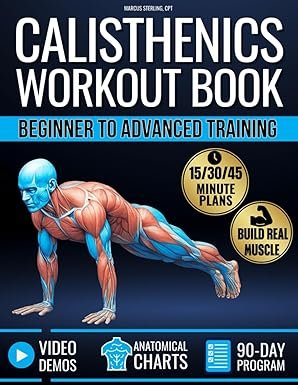
Calisthenics Workout Book for Beginners & Advanced Training addresses that gap directly. Instead of relying on motivation or novelty, the book anchors its approach in progression and mechanical efficiency. It treats bodyweight training as legitimate strength work rather than a warm-up or conditioning afterthought.
Progressive Calisthenics Strength Training Starts With Intelligent Progressions
Effective bodyweight training depends on progression, not randomness. Too many programs jump from basic movements to advanced skills without preparing the joints, connective tissue, or nervous system. That approach leads to breakdown long before strength develops.
This book takes a different path. It breaks movements down into manageable steps and builds them back up through leverage changes, range-of-motion control, and tempo adjustments. Each progression earns its place in the program. Push-ups evolve into harder variations through positioning rather than gimmicks. Pulling strength develops through controlled angles and volume management, not forced reps.
By respecting progression, the program allows strength to accumulate steadily. That principle defines progressive bodyweight strength training at its best: gradual increases in difficulty that reinforce proper mechanics instead of fighting against them.
Structured Programming Drives Progressive Bodyweight Strength Gains
Consistency matters, but structure determines outcomes. Training without a clear plan often creates plateaus because the body adapts faster than the program evolves. Random workouts feel productive but rarely deliver measurable progress.
The 90-day framework in this book solves that problem. It organizes training into logical phases that manage volume, intensity, and recovery. Each phase builds on the previous one instead of resetting progress every week. That continuity allows muscles, tendons, and movement patterns to adapt together.
The programming also reduces decision fatigue. Clear prescriptions replace guesswork, which keeps training focused and repeatable. Over time, this structure turns effort into progressive calisthenics strength development rather than scattered workouts that never compound.
Progressive Calisthenics Strength Training Prioritizes Mechanics Over Ego
Bodyweight training exposes flaws quickly. Poor shoulder positioning shows up in push-ups. Weak scapular control limits pulling strength. Without mechanical awareness, reps accumulate while strength stalls.
This book places mechanics front and center. Each exercise explanation highlights positioning, tension, and joint alignment. Visual references reinforce those cues, making it easier to maintain quality as difficulty increases. Instead of chasing exhaustion, the program encourages control and intent.
That focus protects joints while improving performance. Strength grows faster when movements stay clean, and injuries become less likely when mechanics lead the process. In that sense, the book treats progressive calisthenics training as skill development, not just physical output.
A Practical Approach to Progressive Bodyweight Strength Training Anywhere
One of calisthenics’ greatest advantages lies in its accessibility, yet many programs overcomplicate it with unnecessary equipment or elaborate setups. This book keeps training practical. Most workouts require minimal space and no machines, making consistency easier to maintain.
That simplicity doesn’t reduce effectiveness. By manipulating leverage, tempo, and volume, the program creates meaningful overload without external weights. Strength improves because the program respects principles, not because it adds complexity.
For trainees who value efficiency, this approach makes progressive calisthenics strength training sustainable over the long term. Training adapts to real life instead of competing with it.
Final Thoughts: A Reliable Guide to Progressive Calisthenics Strength Training
Calisthenics succeeds when progression replaces guesswork and mechanics guide effort. Calisthenics Workout Book for Beginners & Advanced Training delivers that foundation consistently. It treats bodyweight training with the same seriousness applied to traditional strength programs and provides a clear path from fundamentals to advanced capability.
Rather than promising shortcuts, the book reinforces principles that last. For anyone seeking progressive bodyweight strength training that builds resilience, control, and measurable strength, this resource earns its recommendation.
About the Author
Marcus Sterling, CPT, is a Certified Personal Trainer and fitness author dedicated to simplifying strength training. His work challenges the idea that building muscle and resilience requires complicated routines, expensive memberships, or reliance on machines that disconnect people from how their bodies actually move.
His training philosophy centers on the enduring fundamentals of bodyweight mastery. By emphasizing systematic, step-by-step progressions, Marcus focuses on helping individuals develop real, usable strength through controlled movement and intelligent application of resistance—using only bodyweight and gravity. This approach strips away industry noise and returns strength training to principles that consistently deliver results.
Marcus designs his books as complete, practical frameworks rather than collections of isolated workouts. Titles such as Calisthenics Workout Book for Beginners & Advanced Training function as structured blueprints, supporting both those beginning from the most basic level and experienced lifters seeking higher levels of strength, coordination, and body control.
At the core of Marcus Sterling’s philosophy lies patience, consistency, and long-term thinking. His work reflects the belief that strength is built over time and that anyone can regain ownership of their physical capacity by laying a solid foundation—one capable of supporting performance, health, and resilience for decades.